Spot area and scanning speed are the final pair of parameters that determine whether pulsed laser cleaning machine is stable, controllable, and repeatable.
They must never be evaluated independently. In real engineering practice, spot area and scanning speed always work as a combined system that defines how laser energy is distributed over the surface.
This article explains these two parameters from an engineering perspective, using clear logic and practical analogies that can be directly applied to technical articles, equipment selection, and customer explanations.
1. What Is Spot Area in a Pulsed Laser Cleaning Machine?
Spot area refers to the actual surface area illuminated by the laser beam on the workpiece.
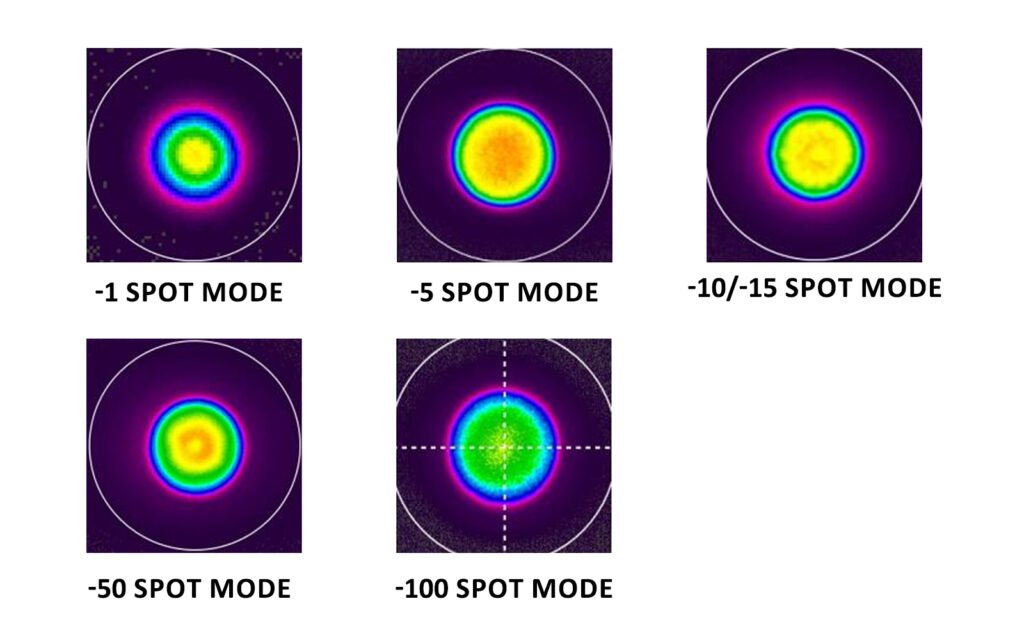
It is determined by several factors working together:
- Spot diameter or spot width × length
- Focal length of the optics
- Beam profile (Gaussian or flat-top)
- Whether a galvo scanning system is used
Common ways spot area is described include circular spots such as Ø2 mm, Ø4 mm, Ø6 mm, or scanned cleaning areas such as 100 × 100 mm and 200 × 200 mm.
2. Engineering Significance of Spot Area
Spot area directly determines energy density per unit area, whether cleaning is concentrated or uniform, and the safety window of the base material.
The core engineering logic is simple. When laser power is constant, a larger spot area results in lower energy density, while a smaller spot area results in higher energy density.
A practical analogy is that a small spot behaves like scraping with a sharp tool, while a large spot behaves like brushing with a wide tool.
3. What Is Scanning Speed in Pulsed Laser Cleaning?
Scanning speed describes how fast the laser spot moves across the surface of the workpiece.
Typical units are millimeters per second or meters per second.
In simple terms, scanning speed determines how long the laser stays on the same point.
4. Engineering Significance of Scanning Speed
Scanning speed directly affects how many pulses hit the same location, whether contamination is fully removed, and the risk of thermal accumulation.
Slower scanning means more pulses per point, stronger cleaning, but higher thermal risk. Faster scanning means fewer pulses per point, safer operation, but potentially incomplete cleaning.
5. Spot Area × Scanning Speed = Actual Cleaning Intensity
In real applications, cleaning performance is never controlled by a single parameter.
Actual cleaning intensity is proportional to:
Single pulse energy × number of pulses ÷ spot area
The number of pulses delivered to one location is determined jointly by repetition frequency and scanning speed.
This is why spot area and scanning speed must always be tuned together.
6. Typical Cleaning Behavior Under Different Parameter Combinations
Small spot with slow scanning produces very high energy density and extremely strong removal capability, but also carries a high risk of substrate damage. It is best suited for heavy rust, thick oxide layers, and localized severe contamination.
Large spot with slow scanning provides uniform energy distribution and stable cleaning results, but thermal accumulation must be carefully controlled. It is suitable for large-area surface treatment and flat-top beam applications.
Large spot with fast scanning produces gentle cleaning behavior and excellent surface consistency, but limited removal per pass. It is ideal for precision surfaces, aluminum and stainless steel, and pre-weld cleaning.
Small spot with fast scanning delivers high impact but insufficient coverage, making missed areas more likely. This combination is generally not recommended as a primary process strategy.
7. Practical Selection Guidelines
| Application Scenario | Spot Area | Scanning Speed |
|---|---|---|
| Heavy rust | Small | Slow |
| General rust removal | Medium | Medium |
| Precision molds | Medium to large | Medium |
| Aluminum alloys / lithium battery | Large | Fast |
| Large-area cleaning | Large | Fast |
8. Common Misconceptions
Common incorrect assumptions include believing that slower scanning always produces better cleaning or that a larger spot area always improves efficiency.
The correct understanding is that spot area determines how energy is distributed, scanning speed determines how long energy remains at one location, and both parameters must be matched to achieve stable, safe, and repeatable results.
9. Summary
In pulsed laser cleaning, spot area determines how energy is distributed, and scanning speed determines how long energy is applied.
Both parameters must be coordinated with single pulse energy, repetition frequency, and pulse width to achieve controlled, low-damage, and repeatable cleaning performance.